
The average B2B sales rep spends less than three hours a day actually selling. The rest goes to admin, research, meetings, and reaching out to people who were never going to buy. Signal-based selling is not a tactic. It is the structural fix for a prospecting model that has been broken for years.
Sales · Business Infomatics Research Desk
There is a version of outbound selling that most sales organisations still run as their primary pipeline generation engine. Build a list. Sequence the list. Follow up on the list. Refresh the list when reply rates fall below acceptable levels and start again. It is a volume game, and the metrics that manage it — emails sent, calls made, meetings booked — reflect that. The underlying assumption is that there are people on every list who are ready to buy, and that if you contact enough of them enough times in enough channels, you will find them.
That assumption used to be defensible when the cost of adding one more name to a sequence was effectively zero. It becomes harder to defend when those sequences arrive in inboxes that are now flooded with AI-generated outreach that has driven average cold email reply rates below two percent, when buyers have developed both psychological and technological filters against generic volume outreach, and when the real signal of buying intent — the evidence that a specific person at a specific company is actively evaluating a solution in your category right now — is available to any sales team willing to act on it.
Signal-based selling is the practice of timing outreach to real behavioural triggers rather than arbitrary sequences built around a static contact list. A job change that puts a new economic buyer in a role where they will need to make purchasing decisions within their first ninety days. A company visiting your pricing page three times in a week. A buyer researching your competitors on G2 or Capterra. A funding announcement that expands the company's budget to solve problems it previously couldn't afford to address. A job posting for a role that indicates the company is building a function your product serves. These signals exist in the data. Acting on them quickly, with outreach calibrated to what the signal suggests about the buyer's situation, is what separates the teams generating pipeline efficiently in 2026 from those running the volume game and wondering why the numbers keep declining.
/
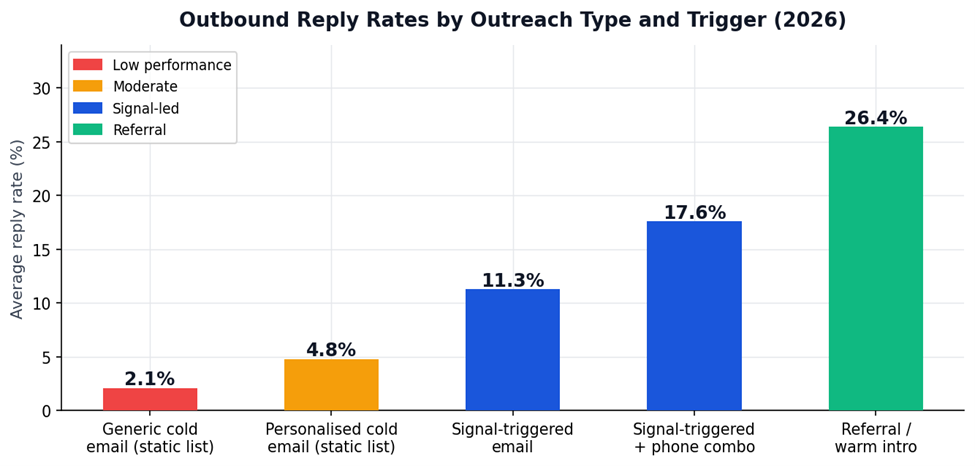
Outbound reply rates by outreach type, 2026. Signal-triggered outreach converts at 5× the rate of generic cold email. Source: Gong, Outreach, and Salesloft composite benchmarks, 2025–2026.
3.7× more likely to hit quota — sales reps who sell on structured intent signals vs. those using static list prospecting. (Landbase, 2026)
What Signals Actually Are — and Which Ones Matter Most
The term 'intent data' has been in the B2B sales vocabulary long enough to accumulate its share of vendor overclaiming, and the category is worth approaching with some precision. Not all signals are equal in their predictive value. Not all intent data platforms deliver what they promise at the price point they charge. And the operational discipline required to act on signals consistently — routing them to the right rep, ensuring outreach happens within the window when the signal is actionable, and personalising for the specific context the signal reveals — is where most signal-based programmes underperform relative to their potential.
The signals with the highest proven conversion lift share a common property: they indicate that something has changed in the buyer's world that creates a specific, time-limited window of receptivity. The change might be organisational — a new executive joining who will want to put their own mark on the function, a company receiving funding that expands their addressable budget, an acquisition that creates a technology consolidation problem. It might be behavioural — activity on review sites that indicates active competitive evaluation is underway, repeated visits to high-intent pages on your website, engagement with content on topics that indicate awareness of the problem your product solves. What each of these shares is a signal of motion in the buyer's world, and it is motion — not static firmographic data — that predicts readiness.
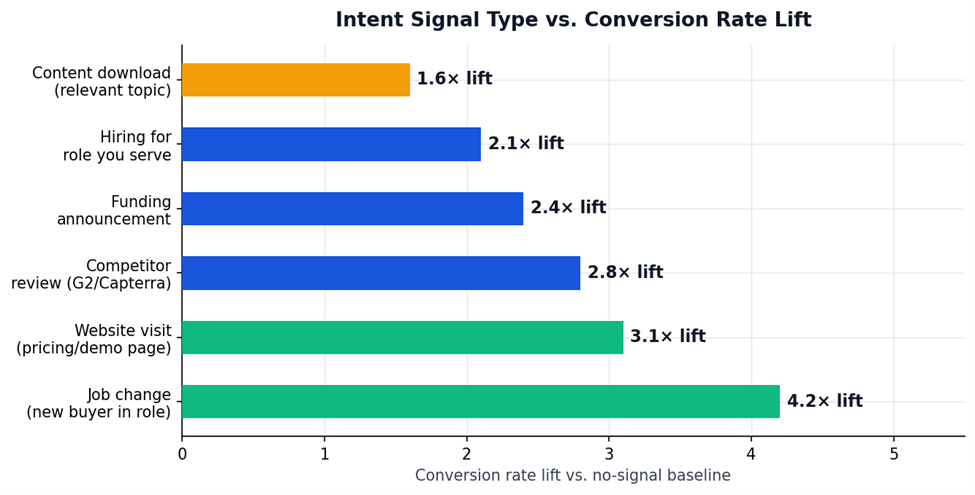
Conversion rate lift by intent signal type. Job changes and pricing page visits produce the highest lift. Source: 6sense, Bombora, G2 Buyer Intent composite data, 2025.
The Decay Problem: Why Speed Matters More Than Volume
Every intent signal has a half-life. The window during which it predicts elevated receptivity to outreach is finite, and different signals decay at very different rates. A pricing page visit from a buyer actively evaluating solutions has a decay curve measured in days — the conversion probability from outreach drops significantly after seventy-two hours and approaches baseline within a week. A job change signal for a new executive entering a relevant buying role has a longer window — typically the first sixty to ninety days in role — but it too decays as the executive settles into their position and makes or defers the key decisions that were live in their first weeks.
This decay characteristic means that the competitive advantage in signal-based selling goes not just to the teams that identify signals but to the teams that act on them fastest. A sales team that routes a high-intent signal to a rep within four hours and that rep acts on it within the same day is competing on a different basis from a team that surfaces the same signal in a weekly intent review meeting and sequences it into a standard outreach cadence starting three days later. The first team is talking to a buyer who is actively evaluating. The second is likely reaching them after they have already had several conversations with competitors who were faster.
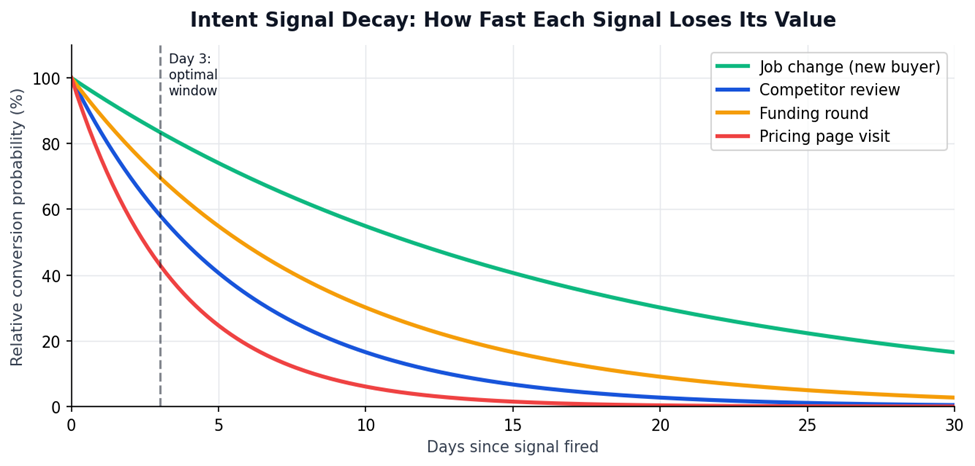
Intent signal decay: relative conversion probability over days since signal f/ired. Pricing page visits lose most of their predictive value within 72 hours. Source: Business Infomatics analysis.
Building a Signal-Based Prospecting System
The Stack You Actually Need
Signal-based selling requires a data infrastructure that most sales teams have not assembled, and the good news is that it is not as expensive or complex as vendor pitches for enterprise intent platforms might suggest. The core requirements are: a source of reliable contact-level intent data — G2 Buyer Intent, Bombora, 6sense, or comparable — that surfaces buying signals in your category; a CRM or sales engagement platform with the routing logic to assign signals to the right rep based on territory, account ownership, or ICP criteria; and an agreed signal response protocol that defines what outreach looks like for each signal type and the time window within which it should happen.
The organisations getting the highest ROI from intent data have typically started narrower than they planned. Rather than attempting to instrument every signal source simultaneously, they identified the one or two signal types with the highest historical correlation to pipeline in their specific business — often job changes at target accounts and competitive review activity — built a tight operational process around those, proved the conversion rate improvement, and expanded from there. The expansion is straightforward once the operational model is working. Getting the first signal type right requires more focus than most teams give it.
Personalisation That Uses the Signal, Not Just the Account
The differentiation between signal-based outreach that converts and signal-based outreach that reads like a version of generic personalisation with the job title swapped out is whether the message is actually calibrated to what the signal reveals about the buyer's current situation. A new VP of Sales who has just joined a company does not need to hear that your sales enablement tool helps sales teams perform better. They need to hear something that speaks to the specific problem that typically sits at the top of a new sales leader's first-ninety-day agenda — establishing visibility into pipeline they didn't build, identifying the reps who will perform and those who won't, and not wanting to inherit a forecasting system they cannot trust. The signal tells you they are new and in a relevant role. What you do with that information is what separates outreach that gets a response from outreach that gets deleted.
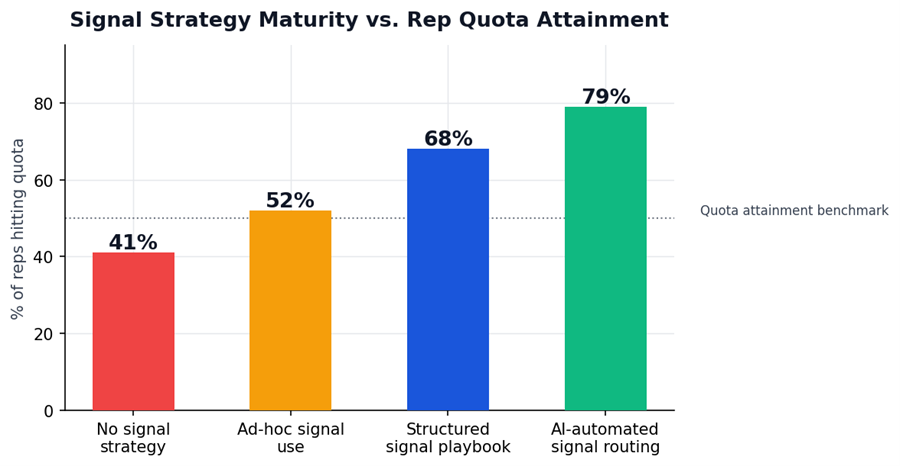
Signal strategy maturity vs. rep quota attainment. Structured signal playbooks nearly double attainment rates vs. no signal strategy. Source: Forrester Sales Operations Survey, 2025.
Measuring What Actually Matters
The metric that tells you whether signal-based selling is working is not the number of signals actioned or the number of sequences enrolled. It is the conversion rate from signal-triggered outreach to qualified opportunity, compared to the equivalent rate from non-signal outreach in the same period, against the same ICP, by the same reps. If that comparison does not show a meaningful lift — typically at least double the baseline conversion rate — either the signal source is low quality, the outreach is not calibrated to the signal, or the routing and response speed is allowing the window to close before the rep acts. Each of these is a diagnosable and fixable problem. But diagnosing them requires measuring the right thing rather than measuring the volume of activity that is easy to count.