Finance teams that spend seventy percent of their time gathering, cleaning, and formatting data are not doing financial planning. They are doing data logistics. AI is eliminating that distinction — and the finance organisations responding well are not just buying AI tools, they are redesigning the function around what the tools make possible.
Finance & Operations · Business Infomatics Research Desk
There has been no shortage of claims about how AI will transform the finance function. The vendor presentations are consistent: AI automates the tedious work, frees finance teams for strategic insight, improves forecast accuracy, and delivers a return on investment that justifies the platform cost many times over. Some of this is accurate. Much of it elides the implementation complexity, the data quality requirements, and the organisational changes required before AI tools can deliver what they promise.
The more useful frame for finance leaders evaluating this landscape is not what AI tools claim to do but what the organisations that have deployed them successfully have actually changed — in their processes, their data architecture, their team skills, and their relationships with business partners. The evidence from early adopters is instructive. The productivity gains are real. They are not automatic. And the organisations capturing them have made investments well beyond the technology purchase that most vendor conversations do not spend much time on.
Deloitte's CFO Signals survey for Q1 2025 found that 73 percent of CFOs believe AI will significantly change the finance function within three years. The same survey found that only 24 percent had deployed AI tools in production beyond pilot stage in their FP&A teams. The gap between expectation and execution reflects both the genuine complexity of the implementation and the fact that the prerequisite investments — particularly data infrastructure — are still being made in most organisations.
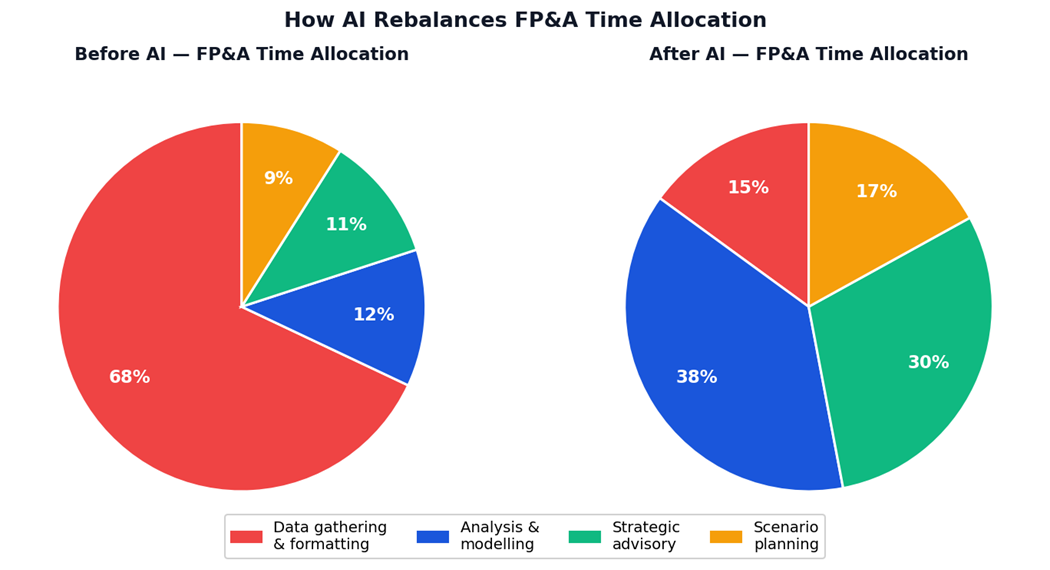
How AI rebalances FP&A time allocation. Data gathering drops from 68% to 15% of team time — releasing capacity for analysis, scenario planning, and strategic advisory work. Source: Deloitte Finance AI Adoption Study, 2025.
73% of CFOs believe AI will significantly change the finance function within three years. Only 24% have deployed AI in FP&A beyond pilot stage. (Deloitte CFO Signals Q1 2025)
What AI Is Actually Replacing in the FP&A Workflow
The specific tasks that AI is replacing in FP&A are worth naming precisely, because the language of 'automating the tedious work' can obscure what is actually changing. The activities being automated are not marginal — they are the activities that consume the majority of many finance team's working time.
Data consolidation and normalisation — pulling actuals from ERP systems, reconciling against budget figures, reformatting for different business unit reporting templates — is the single largest time consumer in most FP&A operations. AI-powered data pipelines that connect directly to source systems, apply transformation logic automatically, and flag anomalies for human review are eliminating weeks of manual work per reporting cycle in organisations that have deployed them well. The prerequisite is data infrastructure that allows systems to connect — which is where many deployments stall.
Variance analysis — explaining why actuals differed from budget across every cost centre and revenue line — is a second major category of automation. Large language models trained on financial data and business context can generate first-draft variance commentary at a quality level that requires editing rather than rewriting. Finance leaders who have deployed these tools report that the time spent on routine variance reporting has dropped by 60 to 70 percent, and that their teams have redeployed that time to understanding the business dynamics behind variances that matter rather than documenting those that don't.
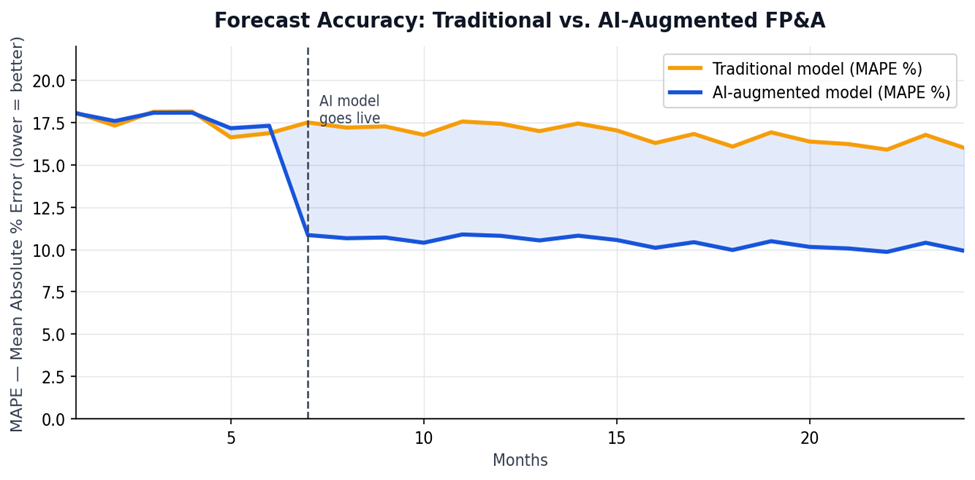
AI-augmented forecasting vs. traditional models over a 24-month period. Post-deployment MAPE drops by ~38% and continues improving as the model learns organisational patterns. Source: Business Infomatics analysis of disclosed implementations.
The Forecast Accuracy Question
Improving forecast accuracy is the most frequently cited business case for AI in FP&A, and it is where the evidence is strongest and most quantifiable. Traditional financial forecasting models — driver-based models built in Excel or FP&A platforms, extrapolating from historical trends with manual adjustment for known business changes — produce forecasts that are systematically biased by the cognitive limitations of the people building them. They anchor heavily on the most recent period. They underweight external leading indicators. They struggle to model non-linear relationships between variables.
AI forecasting models address these limitations by processing more signals simultaneously — combining internal operational data with external economic indicators, market data, and alternative data sources — and by identifying patterns that statistical models based on simplified driver relationships miss. The documented improvements are significant: organisations that have published their implementation outcomes report average improvement in revenue forecast accuracy of 15 to 40 percent, measured by mean absolute percentage error reduction across a comparable rolling period.
The caveat that applies to every vendor's forecast accuracy claim is worth stating clearly. AI forecasting models perform well when they are trained on historical patterns that continue to apply. They perform poorly when the environment changes in ways that have no historical precedent — a supply chain disruption, a geopolitical shock, a regulatory change that restructures the market. The organisations using AI forecasting tools most effectively treat them as one input into an integrated planning process that still relies on human judgment for the scenario modelling that matters most when historical patterns break down.
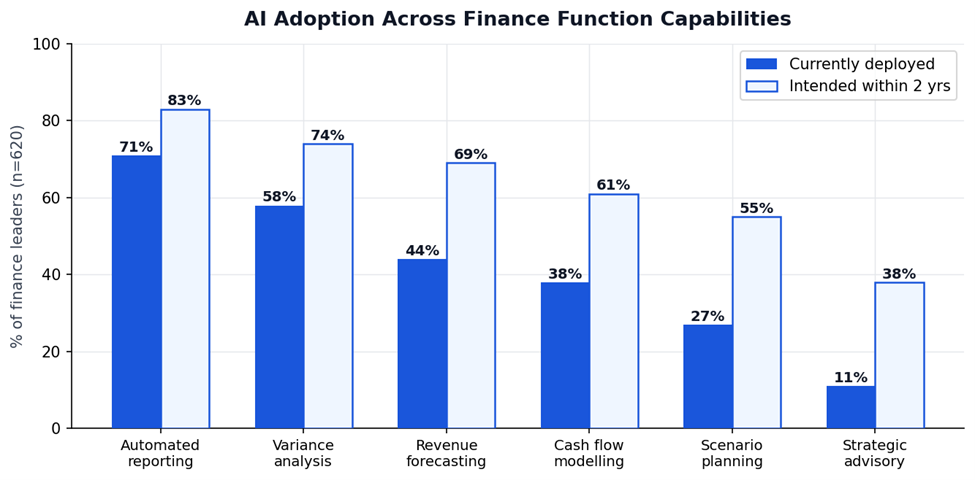
AI adoption across finance function capabilities, 2025. Automated reporting leads at 71% deployed. Strategic advisory remains at 11% — the frontier where most value still lies. Source: Gartner Finance Function Survey, 2025.
The Data Quality Prerequisite That Derails Most Deployments
The most consistent finding from organisations that have attempted AI deployment in FP&A and stalled is that the technology was not the binding constraint. Data quality was. AI tools require clean, consistent, well-structured data to function effectively. The typical enterprise data environment — multiple ERP instances from acquisitions, inconsistent chart of accounts, manually maintained spreadsheets feeding into planning tools, cost centre hierarchies that have been modified repeatedly without systematic documentation — is not that environment.
The investment required to build the data foundation that makes AI FP&A tools effective is typically larger than the tool investment itself, and it is an investment in infrastructure that does not have a direct line to a business case the way the AI tool does. Finance leaders who have navigated this successfully framed the data infrastructure investment as a prerequisite for the broader finance transformation, not as a separate and separable project. They maintained executive visibility on the dependency and protected the infrastructure investment from being de-scoped when budget pressure hit.
The Skills Transformation Running in Parallel
A finance team that is no longer spending most of its time on data assembly is a finance team whose skill requirements have shifted fundamentally. The technical skills that were previously valuable — advanced Excel modelling, knowledge of ERP data structures, manual reconciliation methodology — decline in importance. The skills that become central are the ones the organisation was previously too busy doing data logistics to develop: commercial judgment, business partnering, the ability to translate financial analysis into strategic insight that influences decisions.
This transition is not happening automatically. It requires deliberate investment in development, intentional role redesign, and hiring decisions that prioritise analytical and commercial skills alongside technical finance capability. The finance organisations that are furthest ahead in AI adoption have typically gone through a period of significant team restructuring — not always comfortable — that has reshaped their team composition toward the capabilities that the AI-augmented function requires.
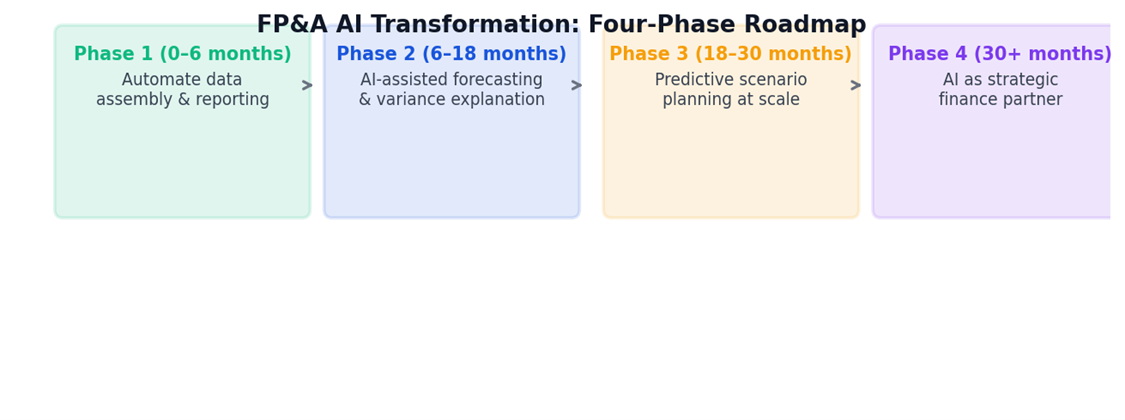
FP&A AI transformation: four-phase roadmap from data automation through to AI as strategic finance partner. Most organisations are between Phase 1 and 2. Source: Business Infomatics framework.
How Finance Leaders Should Be Thinking About This
The question for CFOs and VP Finance leaders is not whether to deploy AI in FP&A — the competitive pressure from organisations that are already doing it is making that a question of when, not if. The more useful questions are about sequencing, prerequisites, and what the function should look like on the other side of the transformation.
The organisations moving fastest are those that treated data infrastructure as the foundational investment, defined the target operating model for FP&A before selecting tools rather than after, and invested in the organisational change management that the skills transition requires alongside the technology deployment. The organisations moving slowest are those that bought AI tools and expected them to work in data environments that were not built for machine learning, or that deployed tools without addressing the process changes and capability development that determine whether the technology delivers value.
The finance function that emerges from this transition looks different from the one that most finance teams were built to be. Less time on data. More time on judgment. Less mechanical production of reports. More genuine partnership with the business functions those reports are meant to serve. The tools make this possible. Making it happen is a leadership challenge, not a technology one.