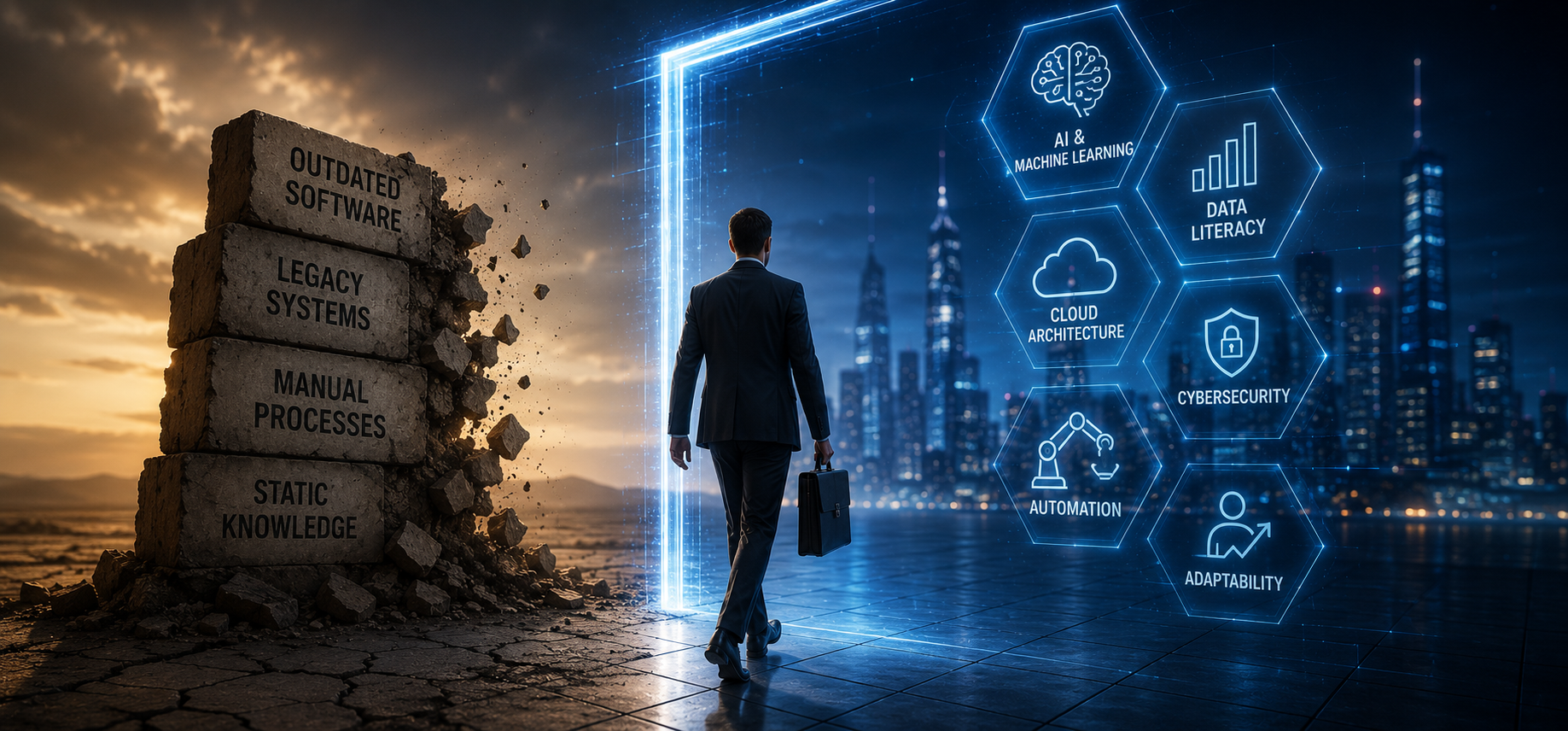
Three years of hybrid work debates have distracted most organisations from the question that actually matters: how do you build a workforce that is productive, engaged, and adaptable when AI is reshaping every role, location flexibility is a baseline expectation, and the skills required are changing faster than any training programme has ever been designed to handle?
The hybrid work debate has consumed an extraordinary amount of leadership attention since 2020. Return-to-office mandates, flexible working policies, desk booking systems, collaboration tool investments, the endless measurement of whether productivity goes up or down when people work from home — all of it has been treated as the defining workforce question of the post-pandemic era. It is not. It is a distraction from a set of changes that are more fundamental, more consequential, and more difficult to address than the number of days per week employees spend in an office.
The organisations that are building genuine competitive advantage through their workforce in 2025 are not the ones that solved the hybrid question. They are the ones that recognised the hybrid question as the wrong question — and redirected their attention to the structural workforce challenges that will determine whether their organisations can compete in an environment where AI is changing what work requires, where the labour market for critical skills is genuinely global and intensely competitive, and where the contract between employer and employee has shifted in ways that most HR frameworks were not designed to accommodate.
The fluid work model that is emerging among the most adaptive organisations is not defined by a policy about office attendance. It is defined by a set of capabilities — the ability to deploy talent to where it is most needed regardless of location or traditional organisational boundaries, the ability to reskill workers at the pace that technological change demands, and the ability to design work around human strengths in an environment where AI is absorbing an increasing proportion of the cognitive tasks that previously defined knowledge work. Building these capabilities is the workforce leadership challenge of 2025. The office attendance policy is a footnote.

The most competitive workplaces in 2025 are not defined by where people work but by how effectively they combine human judgment, creativity, and relationship capability with AI tools that handle the cognitive tasks that previously consumed most of their time. Image: Unsplash (free for commercial use — download and host locally before publishing).
What AI Is Actually Doing to Work — Not the Headline Version
The conversation about AI and employment has been dominated by two competing narratives that are both too simple to be useful. The catastrophist version — AI will eliminate most jobs within a decade — generates attention but misrepresents how technological displacement actually happens historically and overstates the current capability of AI systems to replace the full scope of human roles. The dismissive version — AI is just another productivity tool like the spreadsheet — understates the breadth of the cognitive tasks that current AI systems can perform and the pace at which that capability is expanding.
The more accurate picture, grounded in what is actually happening in organisations deploying AI at scale in 2025, is that AI is rapidly absorbing specific categories of cognitive work while simultaneously creating demand for different categories of human capability that it cannot replicate. The tasks being automated are not uniformly low-skill — they include significant portions of what lawyers, accountants, analysts, customer service professionals, and many other knowledge workers spend their time doing. Routine document review, standard financial analysis, initial customer enquiry handling, report generation, code documentation, and compliance checking are all being handled by AI systems in production deployments across multiple industries.
What this means for workforce planning is not that these roles disappear — it is that they change, fundamentally and quickly. A lawyer spending 60 percent of their time on document review and 40 percent on judgment-intensive work will soon spend 5 percent on document review and 95 percent on judgment-intensive work — if their organisation deploys the AI tools that make this possible, and if the lawyer has developed the capability to work effectively in that inverted ratio. The job has not disappeared. But it has changed enough that the person doing it in 2025 needs meaningfully different capabilities than the person who would have excelled in it in 2020.
The Skills Half-Life Problem
The World Economic Forum's Future of Jobs Report 2025 projects that 44 percent of workers' core skills will be disrupted within five years. This is not a projection about future disruption — it is a description of a process already underway. The half-life of a professional skill — the time before it has depreciated by half in market value — has fallen from approximately ten years in the 1980s to an estimated two to five years for many technology-adjacent roles in 2025.
This pace of change has broken the traditional model of workforce development, which assumed that a person could be trained for a role, perform that role for years with modest ongoing development, and periodically retrain when a major transition was required. That model was designed for an environment where skills remained relevant long enough for training investments to deliver returns over a meaningful period. It does not work when the skills required are changing faster than multi-year development programmes can respond.
The organisations adapting most effectively are shifting from episodic training programmes to continuous learning infrastructure — embedding skill development into the rhythm of work rather than separating it into periodic training events. Microlearning delivered in the context of actual work. AI-assisted coaching that identifies skill gaps from work performance and suggests relevant development in real time. Internal talent marketplaces that give employees visibility into roles and projects across the organisation where their current and developing skills are needed. These are not replacements for formal development programmes — they are the connective tissue that makes those programmes relevant to a workforce whose skill requirements are changing continuously.

The organisations building the most resilient workforces are embedding learning into the flow of work rather than treating development as a separate activity — because the pace of skill change has outrun the traditional training programme model. Image: Unsplash (free for commercial use — download and host locally).
The Employee Value Proposition Has Been Permanently Renegotiated
One of the most significant and least fully acknowledged shifts in the labour market is the degree to which the implicit contract between employer and employee has changed since 2020 — and the extent to which that change is permanent rather than a temporary pandemic disruption that the return to normal will eventually reverse.
Before 2020, the dominant model of employment in most knowledge work organisations assumed that the employer provided the primary structure around which the employee organised their professional and personal life. Office location determined where someone lived. Working hours were largely dictated by organisational norms. The career path was defined by the organisation's structure and the opportunities it chose to make available. Employees who wanted advancement accepted these parameters as the price of access to good jobs at good organisations.
The enforced experiment of remote work during the pandemic gave a significant proportion of the global knowledge workforce an experience of structuring their work differently — and many of them discovered that the autonomous structure produced outcomes, in both productivity and quality of life, that they were not willing to give up when the pandemic ended. The result is not primarily a demand for remote work specifically. It is a demand for genuine autonomy over how, when, and where work happens — with outcomes rather than presence as the measure of contribution.
Employers who have responded to this shift by reinstating pre-pandemic attendance requirements without addressing the underlying autonomy question have discovered a specific talent consequence: the employees most capable of finding alternative employment — the high performers with transferable skills — have exercised that option at higher rates than their less mobile colleagues. The return-to-office mandates that were intended to restore organisational culture and collaboration have often achieved something closer to the opposite — filtering the workforce toward the people who had less choice about compliance rather than those who were most valuable to retain.
The organisations building the most robust talent positions in 2025 have treated the renegotiated employee value proposition as a strategic design problem rather than a policy problem. They have asked what they can offer — in autonomy, in development opportunity, in mission alignment, in management quality — that makes their organisation the choice of talented people who have genuine options. The answers vary by organisation and workforce, but they consistently involve more than office flexibility. They involve the quality of the work itself, the quality of the management relationship, and the credibility of the development opportunity the organisation represents.
AI as a Workforce Tool: The Implementation Gap
The gap between organisations that are genuinely benefiting from AI as a workforce productivity tool and those that have deployed AI without seeing meaningful productivity gains is explained primarily by implementation quality rather than technology quality. The tools available — AI writing assistants, code generation, analytical AI, automated workflow tools — are capable of delivering significant productivity improvements in the right hands. The question is whether the workforce has been given the context, the training, and the permission to use them in ways that actually change how work gets done.
The most common failure mode is deploying AI tools to a workforce that has not been prepared to use them effectively and then measuring productivity at a timescale too short to capture the learning curve. AI tools require a period of skill development before they deliver their productivity potential — workers need to learn how to prompt effectively, how to critically evaluate AI outputs, and how to integrate AI into their specific workflow in ways that save time rather than adding a new task. Organisations that measure productivity in the first month of an AI deployment, before this learning has occurred, consistently find disappointing results and sometimes draw the wrong conclusion that the tool is not delivering value.
The second failure mode is deploying AI tools to specific roles or departments while leaving adjacent roles untouched, creating workflow bottlenecks where the AI-augmented function produces outputs faster than the downstream human process can consume them. AI productivity gains are most fully realised when they are implemented as workflow redesign rather than individual tool deployment — when the entire process from input to output is reconsidered in light of what AI can handle, rather than inserting AI into a process designed for human throughput at every step.
The third failure mode is neglecting the psychological dimension. Research consistently shows that workers who feel threatened by AI — who perceive its deployment as a precursor to role elimination rather than a tool for making their work better — engage with it superficially, use it for low-stakes tasks, and do not invest in developing the AI collaboration skills that would make them significantly more productive. The organisations achieving the highest AI productivity gains are those that have been explicit about the intent of AI deployment — that it is designed to handle the cognitive tasks workers find least rewarding so that human attention can focus on the work that requires human judgment, creativity, and relationship capability.

AI productivity tools deliver their potential only when accompanied by genuine skill development, workflow redesign, and a clear organisational narrative about the role of AI that reduces anxiety and builds engagement. Image: Unsplash (free for commercial use — download and host locally).
The Manager's Role Has Changed More Than Any Other
In the shift to fluid work — distributed teams, AI-augmented workflows, continuous skill change, renegotiated employee expectations — the role of the direct manager has changed more profoundly than almost any other in the organisation. And the management development investment of most organisations has not kept pace with the change.
The traditional manager role was fundamentally supervisory — monitoring attendance and output, allocating work, evaluating performance against defined criteria, managing upward on behalf of the team. In an environment where presence is not observable, where output is increasingly co-produced with AI, where performance criteria change as role requirements change, and where the employee relationship is more explicitly contractual and less loyally institutional than it was a generation ago, these supervisory functions are either automated, irrelevant, or insufficient.
The manager capability that matters most in 2025 is coach rather than supervisor. The ability to understand each team member's development trajectory, to give feedback that is specific, timely, and genuinely useful for growth, to advocate for team members' career development across organisational boundaries, and to create the conditions in which people doing their best work feel that they are doing their best work — these are the capabilities that determine whether talented people stay or leave, whether they bring discretionary effort to their work or do the minimum, and whether the team produces output that compounds in quality over time or plateaus at competent.
Developing these capabilities at the management population level — not just in the exceptional managers who would have developed them regardless of organisational investment — is the most significant return-on-investment available in workforce development right now. The research on manager quality as a determinant of retention, engagement, and productivity is unambiguous and consistent across industries and organisational contexts. The gap between most organisations' investment in management capability development and the returns available from closing it is one of the most consistent findings in workforce analytics.
What Workforce Leaders Should Actually Focus on in 2025
For CHROs and people leaders navigating an environment of AI disruption, renegotiated employee expectations, accelerating skill change, and persistent leadership pressure to reduce headcount while increasing productivity, the temptation to respond to each challenge separately — with a new AI policy here, a flexible work framework there, a reskilling programme somewhere else — is understandable but strategically insufficient. These are not separate challenges. They are different expressions of a single underlying shift in what it means to build and sustain a competitive workforce.
The workforce leaders making the most durable progress are the ones who have named this shift explicitly to their executive teams — who have articulated that the organisation is in the middle of a fundamental renegotiation of the employment relationship, simultaneously with a fundamental change in the nature of cognitive work driven by AI, and that both of these shifts require a response that is strategic and sustained rather than reactive and episodic.
From that framing, the priorities become clearer. Building the infrastructure for continuous learning that matches the pace of skill change. Designing AI deployment as workforce augmentation rather than headcount reduction — and communicating that intent credibly enough that workers invest in AI collaboration skills rather than defensively avoiding tools that feel threatening. Developing management capability at scale, because the quality of the direct manager relationship is the single variable most within organisational control that determines whether the renegotiated employment contract works for both parties. And measuring workforce outcomes — retention of high performers, internal mobility rates, skill development velocity, manager effectiveness — with the same rigour applied to financial outcomes.
The future of work is not a destination that organisations will eventually arrive at and stabilise around. It is a permanent state of adaptation to forces that are not going to slow down. The organisations that build the capability to adapt continuously — to learn faster than competitors, to deploy talent more flexibly, to develop AI and human capability in parallel rather than in competition — will not just survive the current transition. They will build workforce advantages that compound in ways their more static competitors will find increasingly difficult to overcome.
The question is not what the future of work looks like. It is whether your organisation is building the capability to shape it.