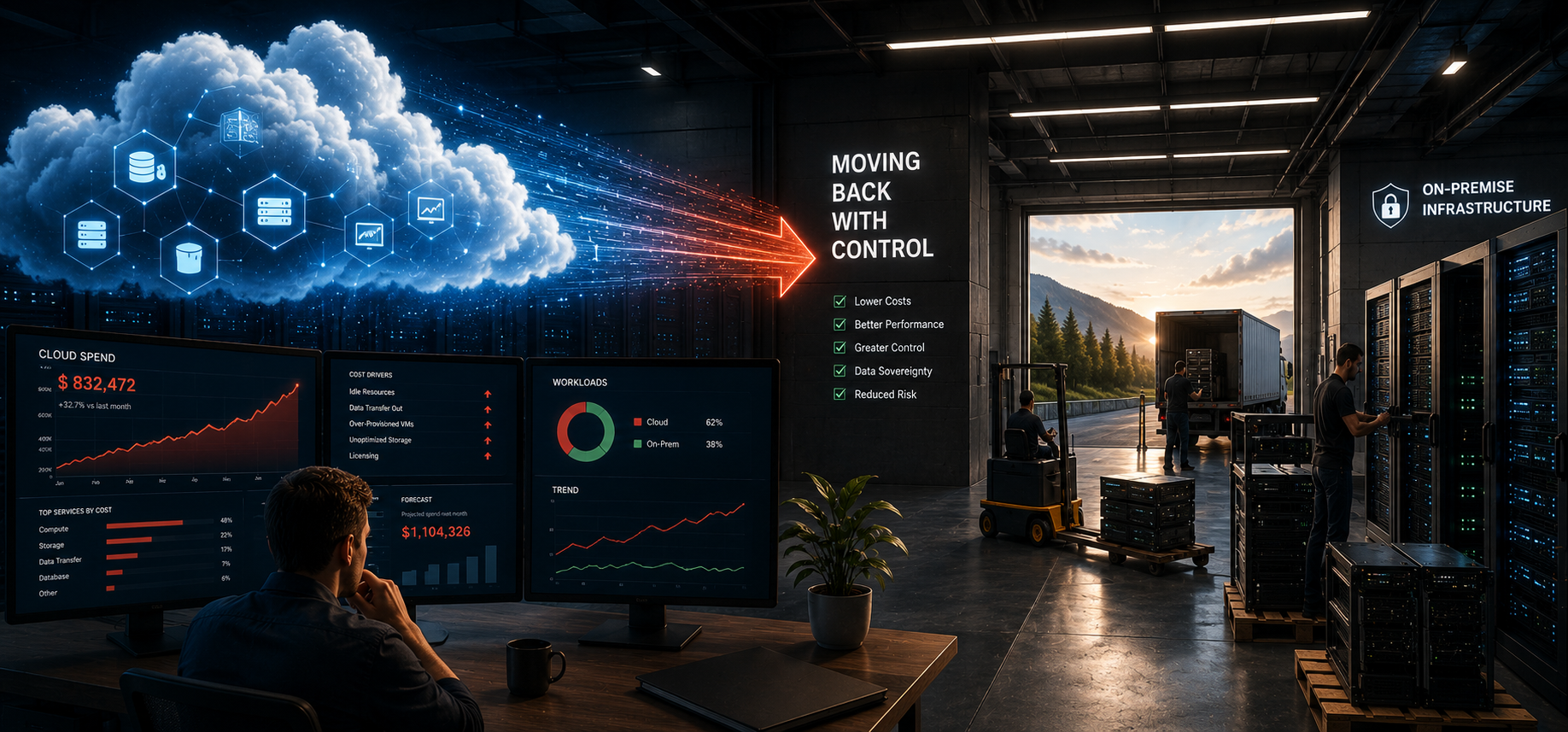
Global cloud spending is crossing $700 billion in 2025. Organizations typically overspend by 25 to 35 percent of that figure. FinOps is the discipline quietly closing that gap — and most infrastructure teams have barely started.
There is a specific kind of meeting that happens in almost every technology company at some point. Someone pulls up the monthly cloud bill, someone else goes quiet, and the room fills with a familiar mix of confusion and discomfort. The number is larger than expected. No one can immediately explain why. And everyone is aware that asking too many questions will reveal that no one has been watching closely enough.
This is not a small company problem or a startup problem. It is an everyone problem. Research consistently shows that organizations — regardless of size or technical maturity — overspend on cloud infrastructure by 25 to 35 percent of their total cloud bill. In high-growth environments where AI and data workloads are driving demand for expensive GPU instances, that figure can exceed 40 percent. At scale, this is not inefficiency. It is a meaningful competitive disadvantage disguised as a line item.
The shift that is happening across enterprise infrastructure teams right now is the move from reactive cloud management — reviewing bills after the fact, running occasional rightsizing exercises, hoping someone noticed the idle resources — to proactive, continuous cloud financial management. This shift has a name: FinOps. And in 2025, it has moved from being a niche discipline practiced by a handful of cloud-native companies to something Gartner and Forrester are calling a strategic imperative for any organization serious about cloud at scale.

Cloud cost optimization has moved from an engineering concern to a boardroom discussion — with FinOps emerging as the operational framework connecting the two.
Why Cloud Bills Keep Growing Even When Usage Stays Flat
Most infrastructure leaders understand the obvious causes of cloud overspend: over-provisioned instances, idle resources that were spun up for a project and never shut down, reserved capacity that was purchased but not fully utilized. These are real and addressable problems. But they are not the whole story — and fixing them alone will not solve the problem for long.
The deeper issue is architectural drift. As teams grow, environments multiply, and the distance between the engineers making provisioning decisions and the finance team reviewing invoices widens. A developer creates a compute instance to test something, forgets to tag it, moves on to the next sprint. Three months later it is still running, consuming cost, assigned to no project and owned by no team. Multiply this pattern across hundreds of engineers and dozens of environments and you have a sprawl problem that no single audit can permanently fix.
The second layer of complexity is the multi-cloud reality most enterprises now operate in. Seventy-eight percent of organizations run workloads across multiple cloud providers — AWS, Azure, Google Cloud, and often a private cloud or colocation layer on top. Each provider has its own pricing model, its own discount structures, its own terminology for equivalent services. Managing cost across this environment with spreadsheets and monthly reviews is not a strategy. It is a hope.
The Kubernetes Problem Nobody Budgeted For
One of the most significant sources of unexpected cloud spend in 2025 is Kubernetes. Container orchestration has become mainstream — most modern applications run on it — but its cost profile is genuinely complex in ways that many teams underestimated when they adopted it. Containers are ephemeral, scaling behavior is unpredictable, and network costs within Kubernetes clusters are frequently underestimated in budget projections. Teams that rightsized their EC2 fleets meticulously are often running Kubernetes workloads with no visibility into cost at the namespace or pod level. The bill arrives and nobody can explain which workloads drove it.
FinOps practitioners in 2025 are increasingly focused on container-level cost visibility as a foundational requirement — not a nice-to-have. Without the ability to attribute cloud spend to a specific team, product, or workload inside a Kubernetes environment, cost accountability is impossible and optimization efforts stall.
Effective cloud cost management in 2025 requires visibility at the workload level — not just the account level — across every cloud environment the business runs.
What FinOps Actually Is — And What It Isn't
FinOps is not a tool. It is not a job title, though FinOps practitioners are increasingly a recognized function in large organizations. It is a cultural and operational practice that brings engineering, finance, and business teams together around a shared understanding of cloud spend — what it is, what it buys, and whether that trade-off is the right one.
The FinOps Foundation defines three phases of maturity: crawl, walk, and run. Most organizations are still in the crawl phase — they have basic cost visibility, they run periodic reviews, and they occasionally act on recommendations from their cloud provider's native cost tools. The walk phase involves real-time visibility, team-level accountability, and regular optimization cycles. The run phase — where the most sophisticated cloud operators live — involves AI-driven anomaly detection, automated rightsizing, and cost embedded directly into engineering workflows so that every infrastructure decision is made with full cost context.
The FinOps market, valued at $5.5 billion in 2025, is growing at a compound annual rate of nearly 35 percent. That growth reflects genuine enterprise urgency. When cloud spend is a line item measured in millions per month, a 20 percent reduction is a meaningful number. The financial case for FinOps investment is rarely complicated — it pays for itself almost immediately.
AI Is Changing How Cloud Cost Management Works
The most significant development in cloud cost management over the past twelve months has been the application of AI to the problem itself. Analysts have started referring to 2025 as the year cloud cost management went AI-native — with more than 60 percent of enterprises reporting that they now use some form of AI assistance or automation in their cloud financial workflows, according to TechRadar research.
This is a genuine shift in what is possible. Manual rightsizing audits are often obsolete by the time the report is finished — the environment has changed, workloads have shifted, and the recommendations are no longer accurate. AI-driven systems can analyze utilization patterns continuously, identify anomalies in real time, and recommend or automatically execute rightsizing actions before waste accumulates. For GPU-intensive AI workloads — which are among the most expensive infrastructure investments organizations are making right now — this kind of continuous optimization is not optional. The cost of a single idle A100 instance over a month is significant. The cost of a fleet of them running at 40 percent utilization is a strategic problem.
The Cultural Problem That Technology Cannot Fix Alone
Every infrastructure leader who has tried to implement cloud cost controls will tell you the same thing: the technology is the easy part. The hard part is getting engineers to care about cost at the same level they care about performance and reliability.
This is not a criticism of engineers. It is a reflection of how most engineering incentive structures work. Engineers are measured on uptime, feature velocity, and system reliability. Cost is someone else's problem — specifically, it is the finance team's problem when the bill arrives. This structural disconnect is the root cause of most cloud overspend, and no dashboard changes it on its own.
The organizations that have genuinely moved the needle on cloud cost culture are the ones that made cost a first-class engineering metric — visible alongside latency and error rates in the same dashboards engineers use every day, and tracked at the team level so that accountability is specific rather than diffuse. When a team can see their own cloud spend in real time and is expected to explain significant variances, behavior changes. Not because engineers suddenly care more about money, but because cost becomes part of the definition of good engineering practice rather than someone else's concern.

FinOps only works when engineering and finance teams share the same data and speak the same language about cloud investment decisions.
Where to Start If Your Cloud Costs Feel Out of Control
If your cloud bill feels unpredictable and your cost review process is mostly reactive, the following sequence has worked repeatedly for organizations across industries and cloud maturity levels.
The first step is getting genuine visibility — not the high-level account summaries your cloud provider's console shows by default, but workload-level attribution that connects every dollar of spend to a team, a product, and a business purpose. This requires consistent resource tagging, which is unglamorous but foundational. Without it, every optimization effort is guesswork. Most organizations discover when they first attempt this that their tagging coverage is far lower than they assumed. Fixing it takes time but unlocks everything that follows.
The second step is establishing ownership. Every significant cloud resource should have a named owner — a team or individual who is accountable for that resource's cost and has the authority to modify or delete it. This sounds obvious, but in most organizations it does not exist. The zombie resources consuming cost with no owner exist because ownership was never defined when the resource was created. Requiring ownership tagging at provisioning time — enforced at the infrastructure-as-code level, not just as a policy — prevents the problem from recurring.
The third step is building a regular rhythm. A monthly cloud cost review that involves both engineering and finance, focused not on blame but on shared understanding of what changed and why, is the single highest-leverage operational habit most organizations can build. Over time these conversations become faster, the anomalies become smaller, and the culture around cloud spend shifts from anxious to routine.
The fourth step — and the one that separates crawl from walk — is automation. Not full autopilot, but automated recommendations with defined approval thresholds. Rightsizing suggestions that are automatically implemented for non-production environments, escalated for human review in production. Alerts that reach the right team within hours of an anomaly rather than weeks later when the invoice arrives. The goal is to make the gap between insight and action as small as possible, because cloud waste compounds fastest when nothing happens for thirty days.
The Sustainability Angle Nobody Is Talking About Yet
There is one more dimension to cloud cost management that is becoming impossible to ignore in 2025: sustainability. Energy efficiency has become a genuine factor in cloud infrastructure decisions — partly because regulators in Europe and increasingly elsewhere are requiring it, and partly because the energy consumption of AI workloads specifically has drawn public attention in a way that makes boards and investors ask questions they did not ask two years ago.
Cloud providers are responding. Google Cloud's carbon-conscious computing system routes workloads to regions with lower carbon intensity. AWS has made significant commitments around renewable energy. Azure offers sustainability dashboards alongside cost dashboards. The infrastructure teams that are paying attention are discovering that carbon-optimized workload placement and cost-optimized workload placement are often the same recommendation — idle resources waste both money and energy, and over-provisioned instances are inefficient in both dimensions simultaneously.
This convergence is not accidental. It is the beginning of a framework where cloud infrastructure decisions are evaluated on three dimensions simultaneously: cost, performance, and environmental impact. Organizations that build this framework now — before regulation requires it — will have a significant advantage when sustainability reporting becomes mandatory in their markets, which, in most jurisdictions, is closer than most boards realize.